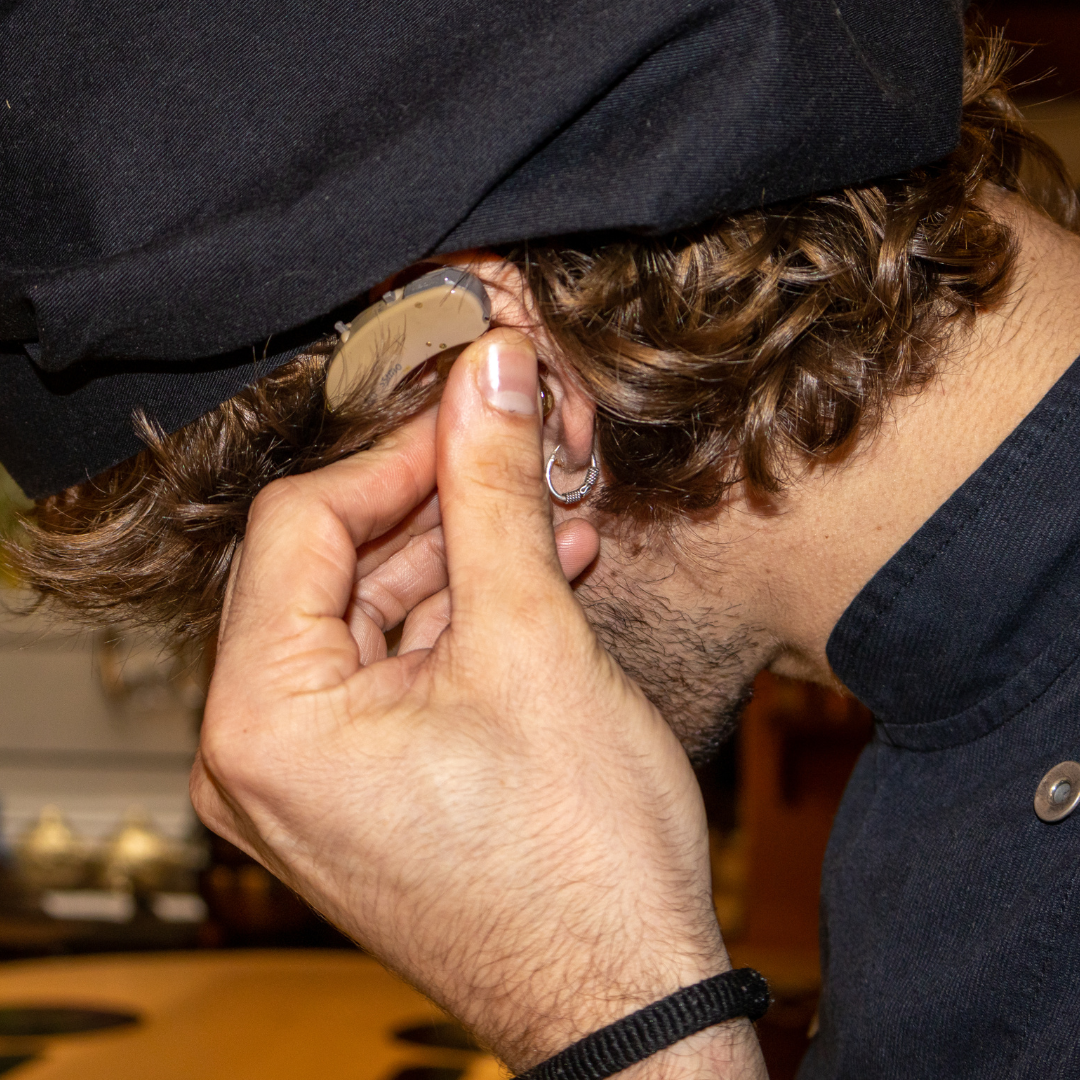
Restaurant conversations can be difficult to follow when environmental noise competes with your focus and hearing. Our practice can evaluate hearing in both quiet and noisy conditions to identify what makes these environments difficult. When we isolate the root mechanism behind your difficult hearing, we guide you toward customized communication solutions.
How Can Hearing Seem Normal at Home but Fail in a Restaurant?
Low-noise environments yield an advantageous signal-to-noise ratio where primary speech remains significantly louder than background sound. Modern restaurant environments create the complete opposite listening environment. Competing conversations, background music, tableware clatter, and acoustic reflections clash with incoming speech, making auditory processing exceptionally strenuous.
This symptom pattern often reflects underlying high-frequency hearing loss, central processing dysfunction, or physiological aging of the auditory nerve. Attention, fatigue, dim lighting, and distance from the speaker may make it worse. It is common to display normal baseline audibility on conventional hearing tests while failing comprehensive speech-in-noise testing. Difficulty in restaurants deserves evaluation even when everyday hearing seems normal.
How Is High-Frequency Hearing Loss Diagnosed?
Our diagnostic process starts with a detailed case history reviewing problematic listening scenarios, occupational noise exposure, tinnitus, ototoxic medications, and familial genetics.
Through pure-tone audiometry, we determine your faintest auditory perception across low to high pitches utilizing both air and bone conduction testing. High-frequency hearing loss commonly presents on the audiogram as a characteristic precipitous drop in the higher frequency ranges. Additional testing may include tympanometry to assess middle-ear function and word-recognition testing to measure speech understanding.
A quiet sound booth cannot replicate complex dining room acoustics, which makes clinical speech-in-noise testing especially informative. The test assesses word and sentence discrimination as background acoustic competition intensifies. Together, these audiological findings indicate whether the issue involves sound audibility, speech intelligibility, noise-processing dysfunction, or multiple compounding factors.
How Do Auditory Processing Disorders Affect Hearing in Adults?
An auditory processing disorder affects how the central auditory nervous system interprets sound. The peripheral auditory system may register sounds within normal limits, yet the brain falters when separating competing acoustic inputs, sorting speech sounds, or tracking fast speech. Our clinical team starts by examining peripheral auditory thresholds, subsequently deciding if an auditory-processing test battery or multidisciplinary consultation is necessary.
Behavioral Strategies for Hearing Clearly in Loud Venues
Targeted behavioral changes optimize the acoustic speech signal reaching your auditory system while providing clear visual context. Before dining out, choose a quieter restaurant or visit during an off-peak time. Venues with booths, acoustic panels, curtains, carpeting, and other sound-absorbing features may be easier than open rooms filled with hard surfaces.
When arriving at the dining venue:
- Reserve a table located well away from kitchen doors, active bar counters, overhead speakers, and banquet groups.
- Situate yourself with a structural wall behind you to minimize distracting ambient noise from behind.
- Position yourself directly opposite your companions where direct lighting highlights their facial expressions.
- Minimize the physical gap separating you and the person speaking as much as reasonably possible.
- Position your better-hearing ear directly toward your main conversational partner.
- Prompt companions to rephrase unclear sentences with alternate terminology instead of repeating identical words.
- Clarify critical details explicitly instead of nodding along or pretending to catch the message.
- Excuse yourself for a momentary quiet pause when listening exhaustion starts to mount.
- Request that friends speak with crisp clarity rather than speeding through dialogue.
- Elevated yelling distorts auditory signals and seldom improves actual phonetic comprehension.
What Are the Best Tools for Hearing with Background Noise?
Choosing the most effective auditory device requires evaluating diagnostic findings, acoustic lifestyle factors, and the presence of hearing loss. Advanced hearing aids utilize beamforming directional microphones, adaptive noise reduction, and specialized restaurant programs to elevate voices directly ahead while suppressing ambient chatter. Realistic expectations are vital, since even advanced hearing devices cannot completely erase background conversational chatter.
A remote microphone can provide a stronger improvement in the signal-to-noise ratio. The accessory is worn on the lapel or set near the speaker, streaming their voice directly into compatible hearing aids or wireless audio receivers. This reduces the effects of distance and surrounding noise.
Additional effective assistive technologies include:
- Portable table microphones for managing multi-speaker dinner conversations
- Hearing-loop telecoils that stream clean audio in loop-equipped establishments
- Mobile speech-to-text applications delivering instant visual captions during dinner
- Advanced hearables incorporating assistive directional listening programs
- Sound-meter apps and acoustic dining directories for locating quiet venues
We can compare options, confirm compatibility, and teach you how to use the selected device.
Clinical Audiology Care for Hearing in Complex Noise
A professional clinical assessment moves beyond basic baseline statements like “I hear fine in quiet rooms.” We examine the challenging acoustic venues, conversational setups, and noise profiles you encounter to select appropriate diagnostic tests. Your diagnostic appointment may incorporate pure-tone air and bone thresholds, acoustic middle-ear testing, word-recognition scores, and speech-in-noise measures. Specialized auditory-processing testing can be ordered when patient history and preliminary audiometric findings warrant deeper neural investigation.
Sudden, one-sided, or rapidly worsening symptoms may require medical evaluation by an ear, nose, and throat physician. Dedicated individualized care pinpoints the underlying auditory cause rather than dismissing your struggles as standard restaurant noise.
Request an Audiology and Hearing Evaluation Today
If dining in loud spaces leaves you feeling isolated, fatigued, or guessing at missed speech, contact us to schedule a thorough hearing evaluation. We will help you navigate hearing in noisy environments by implementing advanced hearing aid options, assistive accessories, or therapeutic auditory strategies tailored to your lifestyle.
Reach out to our audiology clinic today to schedule an evaluation and begin enjoying clear, effortless conversations.